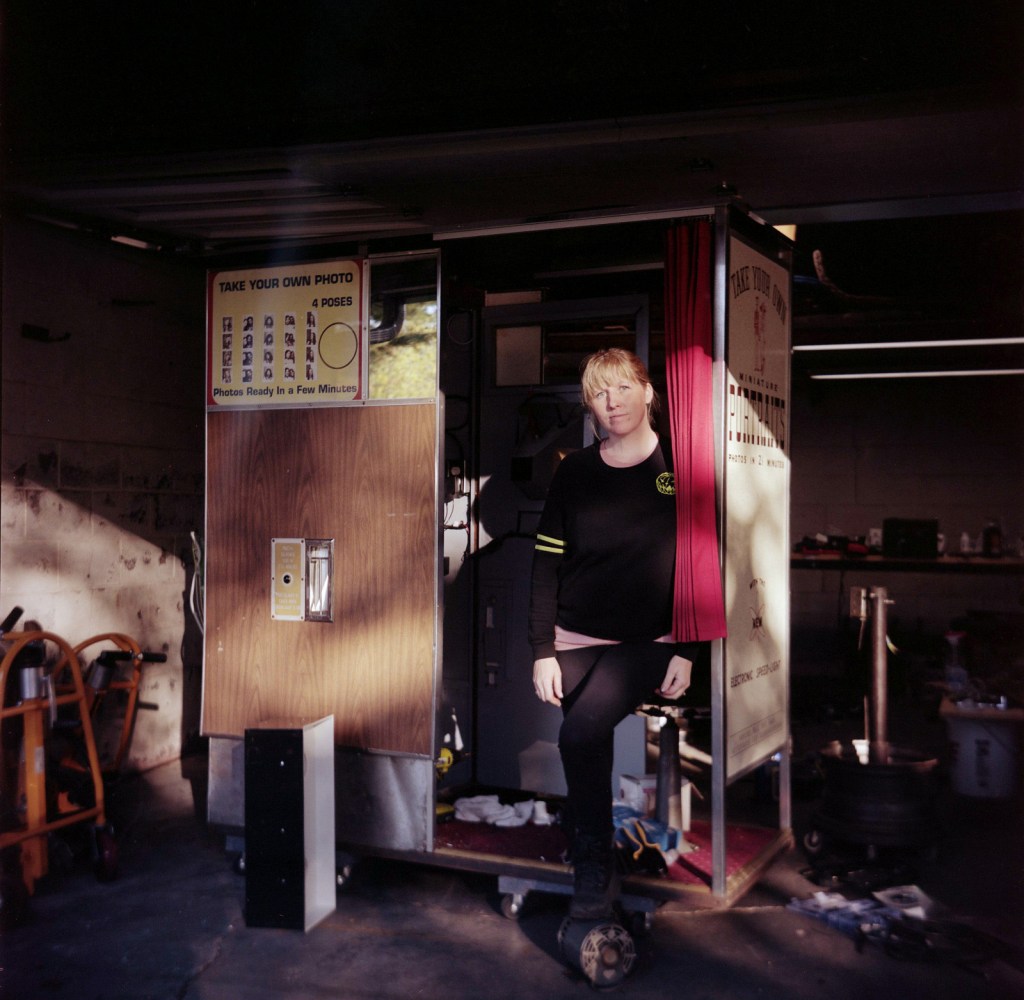
Text by Allie Moustakis. Images courtesy of Bre Conley Saxon.
Bre Conley Saxon bought her first analog photobooth in 2009 for $200 at a thrift store in Alabama.
She had no idea how it worked but took it home anyway. The internet didn’t offer much help, as most of what she found was about digital booths, which started replacing older machines in the 1990s.
Five years later, she finally tracked down an operator in New Jersey who still serviced analog booths and paid him to show her the basics.
“It’ll take 10 years before you know how to run these things,” she recalls being told.
Saxon came up through photography the straightforward way. She took a darkroom class at her high school in Georgia, earned a BFA from the University of Alabama, then attended the now closed Brooks Institute of Photography in California, before returning to Alabama and spending the next decade shooting weddings.
By the time the COVID-19 pandemic hit, she’d reached what felt like a professional plateau. She’d gotten as good as she wanted to be at wedding photography and wanted to be the best at something else.
That something else ended up being vintage analog photo booths.
Her one booth became two, and now she has dozens of machines across the country.
Today, she runs AUTOPHOTO, the business behind a growing network of analog booths placed in bars, venues and other public spaces in the U.S. and New York City’s first photobooth museum, partnering with various technicians to showcase their machines to the public.
When you bought your first photobooth in 2009 you said it was a dying art. Why do you think analog photography, especially the photobooth, is having a resurgence right now?
Part of it comes from what I felt coming out of the pandemic. Being locked up for a while made me realize how important tangible things are. There were a few years where everything was just in the cloud.
Even with my wedding clients, people stopped printing albums, and then suddenly, they started getting their images on discs.
At some point, people were realizing they never looked at them, or they were getting lost in whatever cloud.
I also own a small record label with my husband, so we watched the resurgence of even vinyl in the last few years.
I think, just in general, everything comes back. I hope it stays popular, but I’m sure people will move onto something else.
What does analog photography offer that digital can’t replicate, no matter how advance it becomes?
I learned on both, and I was a hybrid shooter. But honestly, I always loved my analog film pictures more than my digital.
I think it’s because they’re more precious and you kind of have to slow down. You’re not taking 10 of the same or getting to redo it. There’s also the experience of waiting for it and not knowing what it’s going to be like, and then when it comes out, a lot of the time it’s better than you ever expected.
Or sometimes there’s light leaks or characteristics that digital doesn’t have. Digital is almost too perfect in a way. There’s something dreamy and magical about analog and its imperfections.
You shot weddings for a while and now you have people lining up to use your photobooths. Does working within the strict limits of four frames change the way people approach being photographed?
It’s funny looking back at old photobooth strips and how people posed then and how they pose now. It’s a little more selfie feeling. People try to plan out what they’re going to do in their four frames more.
Even at the museum, it’s the first time where I get to really watch the process in depth more and its funny watching people be like, “Ok, we’re going to do this.”
But a lot of the time, it surprises people. That’s my favorite part because it’s a real moment. There’s something to say about the photobooth not having a photographer, like you’re in a safe space to do whatever you want behind the curtain. It allows people to be their true selves, I guess.
Since opening the museum, what’s the most memorable or surprising human moment you’ve witnessed inside — or outside — a photobooth?
We had a guy ask if he could rent the whole space to give a private tour with him and his girlfriend. He planned to propose to her, and he surprised her — he had all this family hiding in the back of the museum. He knew she loved photobooths and they’ve been to the museum a couple of times.
He was like, “We’re going to get a private tour where they talk about the photobooths one-on-one with us.”
It was so special. They did a photo in the booth, and he proposed to her in the booth, and then when she came out all her friends and family were there.
Even when I’m just observing people’s photo exposures and I’ll see so many photos of people where you can tell they’re showing off their ring or their baby announcements.
It’s a way to capture these special moments in life. The photobooths are so timeless. The photos really are like a fine art print to document times with your friends or loved ones or special moments.
People don’t just do it once. They come back all the time. There’s this one girl who comes every month. There’s one family who brings their kid on his birthday every year at some other locations in Boise. It’s special.
What’s the biggest misconception people have before they step into the booth?
A lot of people think they’re going to get two copies and a lot of people think it’s going to print out immediately. We’re constantly educating people that it’s literally a tiny darkroom inside. People really don’t realize or know the difference between analog or digital and that was one of the main purposes of the museum: to help educate on what the difference is and how to spot digital versus analog in the wild.
You describe AUTOPHOTO as a part archive, part gallery, part portrait-making studio. Why was it important to create a space that holds all those roles at once?
Honestly, there’s so much history and, at the same time, not a lot available to the public or online. Since I’ve been doing it, I’ve just learned so much and met so many people.
The Godfather [Jim Henderson] who sold me booths in Chicago died a year ago. I was talking to him right before he passed away about making a book about him because he had so much knowledge. I think him dying was partially the inspiration for creating a space where we tell the history.
I was also kind of hoping that creating the space would bring more people who have knowledge and stories about photobooths to the space so that we could be keepers of history.
A lot of those photobooths aren’t even mine. I could fill it just with all my own photobooths, but I want to give a space for other technicians to have their booths their and their stories. While I take on the risk of rent in Manhattan, they get to have a footprint there. That’s the most important part to me.
How do you see AUTOPHOTO evolving as interest in analog culture continues to grow?
I have about 20 more booths to refurbish, and I’m still figuring out what we’re going to do with them.
I have a partner in Canada, and we want to tell the Canadian history, too. We’ll probably do a space similar somewhere in Canada.
I joke about having a photobooth in every state, because it clearly wasn’t a good business decision to have 24 booths in 10 states. But I just wanted to make it available and accessible to everybody.
Since there are so few booths, I don’t really care about saturating one market or city. I kind of feel like the more I spread out, the more people I teach, the more people who will use it, and the survival of it will be more likely.
*This interview has been edited for clarity and length.


Leave a Reply