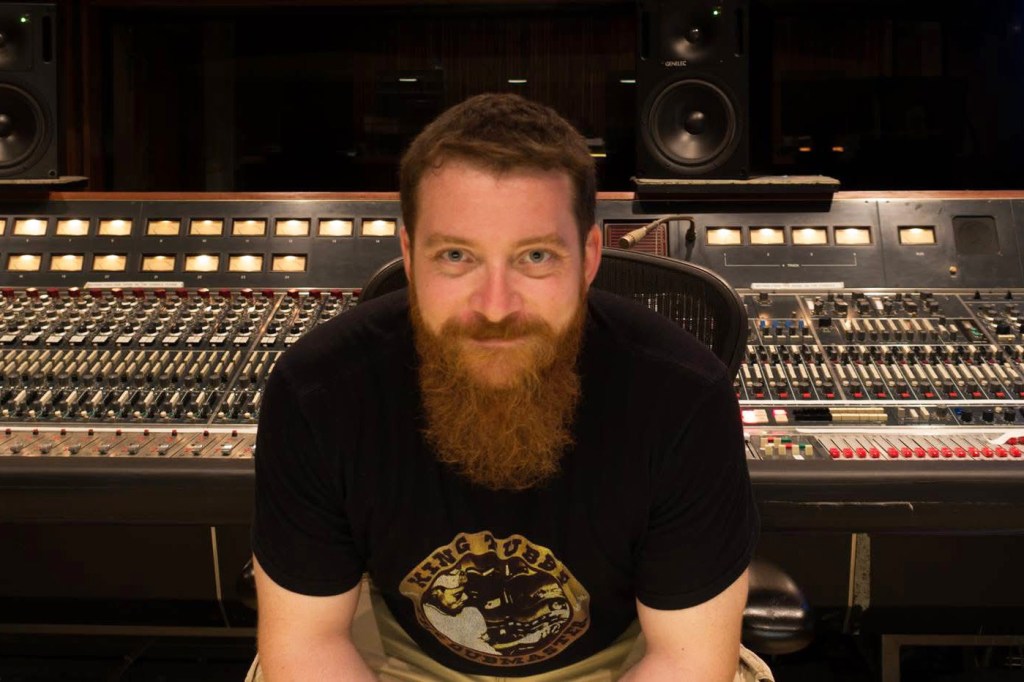
Text by Peter Shea. Image courtesy of Own Mulholland.
In the main recording and mixing suite of Big Sound studio in Chelsea, Owen Mulholland leans forward and eyes the audio waveforms flowing like a river across his computer monitor.
He’s surrounded on three sides by a wraparound desk. The plush carpets, sofas and sound dampeners in the room make the clicks of his computer mouse the only noticeable sound.
For a space built for the production of sound, the room is nearly silent.
Mulholland has been a working audio engineer, mixer and producer in New York since 2012 and has been behind the boards during recording sessions with artists as diverse as Paul Simon, Fleet Foxes, Norah Jones, Erykah Badu, Maxwell and more.
Over the past five years, he has become one of the go-to engineers and mixers for many of New York’s jazz and experimental musicians, a community that thrives despite the ever-present struggles of the working artist in America in 2026.
Mulholland sat down with me recently to discuss his work.
Tell me who you are. How do you define yourself as an artist, producer, creator and all that?
Well, I’m an engineer. An audio engineer. I mostly deal with almost exclusively music as opposed to, like, film and stuff like that. Genre-wise, I mostly deal with jazz and experimental music.
Tell me about the typical artist that comes to you. How do you even find these artists?
It’s all word of mouth. New York has an amazing jazz scene, you know, pretty much the best one in the world. The jazz scene is very tight-knit. People talk to each other. Every impression I give is really important. That can make or break the next relationship. I don’t do any advertising outside of just the random Instagram post.
What’s your role in creating an album?
I can be hired to record some overdubs for the album, which means just, like, single instruments at a time over an existing multi-track kind of session. Say somebody needs to plug in some extra vocals or something like that on some takes that another band already did. That’s called an overdub.
You can do that or mix an album, which means basically get all the multi-track, all the individual channels from each microphone, and bounce them and process them in different ways, down to two channels, stereo, speakers, left and right.
Outside of that, there’s mastering, which is basically dealing with those two channels that I’ve mixed down to, and just kind of sweetening it a little bit more to make it radio ready, to make every song on an album consistent as far as level.
Then, outside of that is producing. I usually wear that hat on every roll because that’s just the way things are right now. Every engineer is kind of a producer to varying degrees.
What makes you good at your job?
I’m good with people, from what I hear. I found that makes the biggest difference as far as business coming in. If you’re an asshole, you’re not going to get a call. It helps to be good technically at what you do but personality is the main thing from what I’ve found.
I found that the hard way, too.
People come to me also because they like the way the records that I work on sound. Not that I have a signature sound or anything like that. I just try to make it sound good to my ears. And, fortunately, that resonates with other people.
What about the scene calls to you?
Well, jazz in general. I love the workflow. I’ve worked in a lot of different genres and I’m very fortunate to have kind of stumbled and fallen into the jazz scene. The workflow is so much more fun than pop and rock stuff.
With jazz, every single take is different, you know? A lot of it is improvised. Even the parts that aren’t improvised, the melodies and the heads and everything like that, these artists, you know, they’re incredible? They can put just different flavors on every take. It kind of catches my attention that way.
Whereas doing vocal punches on the same exact approach for the same verse for hours and hours and hours, I don’t know if I could do that for too long.
How does the city inspire you as an artist?
You just walk around and you can feel the energy.
Everybody’s got to do something. Everybody’s fresh to go somewhere and, you know, further their own careers. It’s easy to feed off of that.
Plus, just the amount of live music in New York is unparalleled to anywhere. That’s that’s a great source of inspiration. Just being able to walk outside, look up on your phone really quick what’s happening that night. You have a list of things to do, or you just walk around places like the Village, especially the West Village, where there’s a lot of clubs and everything.
You just follow your ears and you can just stumble into an amazing show.
Tell me about someone you’re working with right now that excites you or someone that you’ve recently worked with?
Well, there’s a lot. But a record that came out a few months ago that I’m really proud of is Patricia Brennan and her group with an album called “Of the Near and Far.”
That was really cool. Patty is an amazing vibraphone player. And her band on that record consisted of drums, upright bass, piano, vibes, Patty on marimba as well, and electronics.
Her husband Noel did a whole lot of really awesome electronics and turntable work, which, you know, can go so wrong and so cheesy when you blend hip hop and jazz. That’s happened a billion times. But he really pulled it off in an amazing way. Really enhanced the album. On top of that, there was a string quartet. It was kind of a unconventional lineup.
But Patricia’s writing was incredible. She wrote songs based on tying in the circle of fifths, which is a musical theory. But with constellations in the sky. And it came out just incredible. Other musicians on there were just amazing. That was really inspiring to work on.
It was received very well. We were all kind of holding our breath because it actually asked a little bit more from the listener, a little more patience than her last album, which was still very dense and complex.
Cool. And the visual arts and other arts in New York City, how do you vibe off that and take that into the work that you do?
Well, it definitely ties in. It’s really cool, especially if you feel a little dry as far as inspiration.
If I’m mixing an album and I’m trying to be somewhat creative with it – not just making sure things sound good, but doing some creative delay and effects kind of stuff or whatever, if I find myself kind of out of ideas or in need of inspiration for some kind of something to put it in there creatively, having a visual, really helps.
With this last record I did, I mixed Miles Okazaki, the guitarist. He was basing a lot of his writing off of some amazing pictures that he and his daughter took on a trip out west last year. Incredible pictures. Just, you know, big sky and all that kind of stuff.
He showed me some of those pictures, and it was kind of fun to reference those pictures every now and then while we were mixing. You look at, say, a picture of a big sky and there’s kind of sparse instrumentation or something. You could, translate that into, say, like a longer kind of reverb or just a more ethereal kind of ear candy, you know, rather than punctuated effects like, say, a delay that repeats and there’s a start and stop and everything like that.
The producer, David Breskin, was talking about this one track where he was saying, like, I kind of see this as a sculpture. So, we were kind of almost tracing a sculpture that we didn’t have any idea what it looked like. We were trying to use that as kind of a source of inspiration.
A lot of times, like just opening your mind up to that, your initial thought of like, “Oh, I want to treat it this way” or whatever. It might not end up being that. It’s just another way to go down another road and set yourself up for happy accidents. That can be can be a nice thing, you know, when you’re going after something creatively and you have a path but then you accidentally stumble upon something else.
You got to leave yourself open and be like, “Well, that’s a lot cooler than my original idea.”
 Dreams Are Made Of
Leave a comment